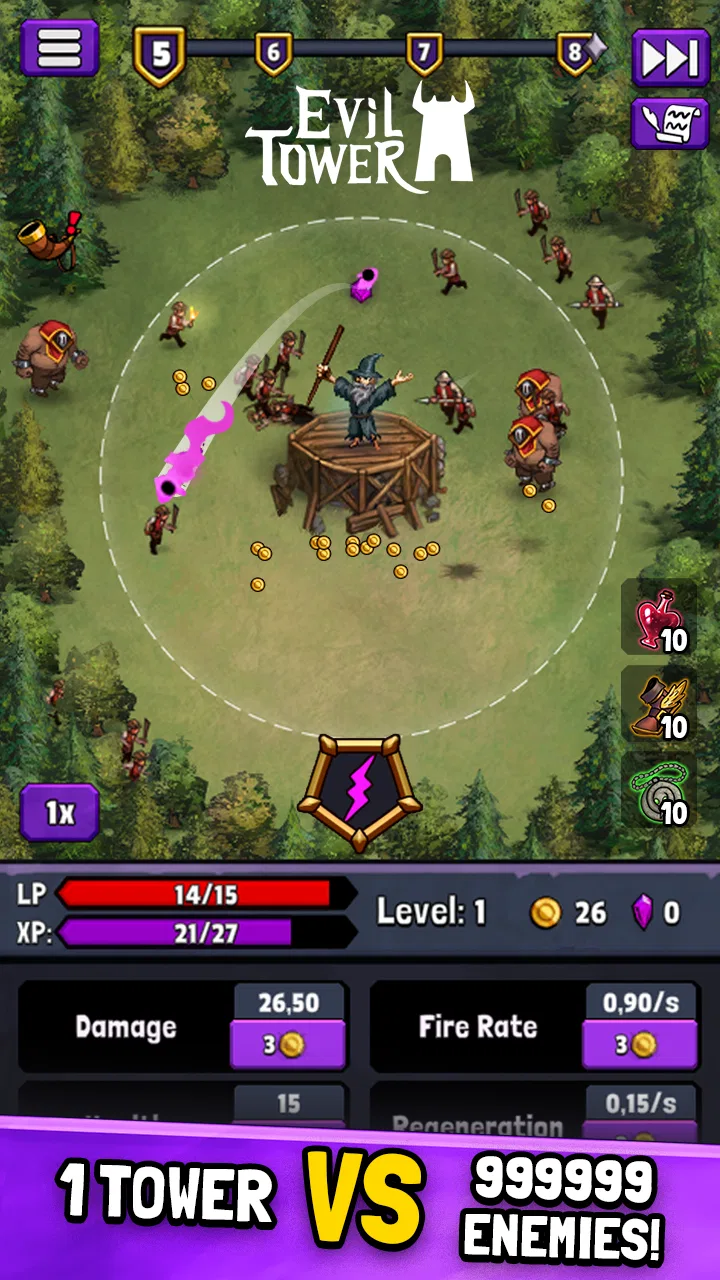
Evil Tower - Idle Defense TD
- 4.4
- Rating
- 1.00M
- Installs
- Free
- Price

 Analysis by App-foxy
I went into Evil Tower - Idle Defense TD expecting a familiar tower-defense loop, but what stood out to me was how directly it asks me to think about two things at once: building the tower and preparing the right battle tactics. It is a free strategy game from Aurecas Games, and its simple premise makes it easy to understand within a few minutes. The more important question is whether that simplicity matches the way you like to play.
For me, this is best viewed as a compact defense game for players who enjoy making gradual improvements, checking progress in short sessions, and deciding where limited attention matters most. It is not the kind of game I would recommend automatically to every strategy fan. If you want a deeply complex battlefield with many layers of control, a traditional real-time strategy game may suit you better. If you like watching a defensive plan develop while making occasional tactical decisions, this one has a more appealing rhythm.
What to consider before choosing Evil Tower
The first decision is about the type of strategy you want. Tower-defense games usually sit between active action and management. You place or improve defenses, respond to threats, and try to make each run stronger than the previous one. An idle defense game leans further toward progress that continues with less constant input. That can be relaxing, but it also means the satisfaction comes from planning and improvement rather than nonstop commands.
You May Also Like

 Blood Strike: 2.5 Anniversary
Blood Strike’s Loadouts Turn Every Drop Into a Tactical Gamble
A close look at Blood Strike’s custom loadouts: how fast access to signature weapons reshapes its battle royale rhythm, rewards preparation, and narrows the gap between fights.

 Pandora - Music & Podcasts
Pandora’s Music Is Easy to Start, but Harder to Recover
Pandora’s strength is its low-effort path from a seed to a station. Its weak spot is how much confidence it asks you to place in connection, setup, and quiet recovery.

 8 Ball Pool
 Is Built on Rivalries, Rematches, and Routine
A close look at the rivalries, rematches, shared routines, and unanswered safety questions that turn a quick pool match into a persistent mobile community.

 Samsung Music
’s Quiet Strength Is Playing What You Already Own
Its reach comes less from spectacle than from dependable access to a personal library. That simplicity is both the app’s strongest retention engine and its ceiling.

 AccuWeather: Weather Radar
AccuWeather Review: A Quick, Clear Forecast for Everyday Decisions
For everyday plans, the best forecast is the one you can understand quickly. AccuWeather makes rain timing, radar, and local conditions easy to act on, with a few trade-offs.

 Hill Climb Racing
Why Hill Climb Racing Still Turns Crashes Into One More Run
A tiny car, a bumpy hill and one more upgrade: Hill Climb Racing keeps resurfacing because its simple chaos makes every near-miss feel personal.
More From Our News Desk



That distinction matters here. I found the game easier to enjoy when I treated each session as a quick tactical check rather than a long, uninterrupted campaign. I would open it, look at how my tower was performing, decide what deserved attention, and then leave it until I felt like checking again. This makes it a natural fit for a commute, a short break, or an evening when I want something strategic without committing to a full-length match.
The game is free to start, which removes the biggest barrier to trying it. It is rated for Everyone, so its presentation is accessible to a broad audience. At the same time, free-to-play design can affect how comfortable a player feels about progression. In-app purchases range from $0.49 to $86.99 per item, so I would recommend deciding early whether you want to play without spending or keep purchases strictly limited. The game is most enjoyable when you choose that boundary before the temptation appears.
Another practical point is device compatibility. The listed minimum is Android 7.0, so people using older phones or tablets should check compatibility before planning around it. The current version is 0.9.2, which also suggests that the experience may continue to develop. I would keep expectations realistic: the core appeal is already clear, but players who expect a very mature, content-heavy strategy package may prefer to wait and see how the game grows.
How I judge the core loop
I look for three things in an idle defense game: whether upgrades feel meaningful, whether the player still makes decisions after the initial setup, and whether returning to the game feels useful rather than obligatory. Evil Tower works best when you use its tower-building idea as a planning exercise. The goal is not simply to tap every available improvement. It is to think about which improvement helps the next obstacle and which one only makes the current stage look stronger.
That is a small but important habit. When I upgrade automatically, progress can feel flat because every choice seems interchangeable. When I pause and ask what is currently stopping my defense, the game becomes more strategic. I recommend identifying the first point where your tower begins to struggle, then investing with that specific problem in mind instead of spreading resources across everything at once.
This approach also helps with idle play. A game in this category can become background noise if the player never has to reassess anything. I found more value in returning after a short interval and checking whether the same weakness remained. If it did, I changed my priorities. If the defense was stable, I could let progress accumulate without constantly interfering. That creates a useful rhythm between active planning and passive development.
Where the tower-building focus works well
The strongest part of the experience is the feeling of turning a vulnerable defense into a more dependable one. I like games where improvement is visible through decisions rather than only through a larger number, and the tower concept gives that progression a clear identity. Even when the session is brief, I have a reason to return: I want to see whether a different investment changes the next attempt.
This also makes the game approachable for people who are new to strategy titles. You do not need to learn an enormous set of systems before understanding the basic objective. The store summary, “Build your tower and prepare your battle tactics,” is brief, but it captures the main expectation accurately without requiring a complicated explanation. The game’s category is easy to recognize, yet its idle emphasis gives it a calmer pace than more demanding defense games.
I particularly enjoyed using it as a low-pressure alternative to competitive games. There is no need to coordinate with teammates or react to another human player’s unexpected move. That makes it suitable for someone who wants strategic thinking without social pressure. It is also a reasonable choice for players who enjoy optimization but do not always have enough time for a full match.
The audience response is encouraging as well. The game has a 4.4 average from around 24 thousand ratings and has passed 1 million installs. I do not treat those figures as proof that every player will enjoy it, but they do indicate that the basic concept has found a substantial audience. The number of written reviews is around 319, which is enough to show that people are discussing the experience while still leaving room for personal testing to matter more than public opinion.
Three habits that make the game more enjoyable
My first useful habit was to stop treating every available upgrade as equally valuable. In a tower-defense game, the most visible improvement is not always the most important one. I would first identify the point where the defense failed, then choose the change most likely to address that weakness. This avoids the common mistake of making the tower generally stronger while leaving its actual bottleneck untouched.
The second habit was to separate checking progress from making a purchase. Because the game is free and includes optional items, it is easy to connect a moment of frustration with the idea of spending. I found it better to close the game after a disappointing result, return later, and reassess the plan with a clearer head. That simple pause helps preserve the strategic part of the experience and keeps optional spending from becoming the default solution.
The third habit was to use short sessions deliberately. Instead of leaving the game open and repeatedly checking it, I would decide what I wanted to learn from the next return: whether a chosen upgrade solved the current problem, whether the tower could handle the next push, or whether I needed to change priorities. This turns idle progress into a small experiment. It also prevents the game from taking up attention without giving anything meaningful back.
These habits are not complicated, but they change the feel of the game. Without them, an idle defense title can become a sequence of taps. With them, each return has a purpose. That is where I think Evil Tower has more depth than its short description suggests: the game rewards the player who treats progression as a series of decisions rather than a checklist.
Where it wins, and where another strategy game may fit better
Compared with a conventional tower-defense game, Evil Tower is more comfortable for players who prefer gradual progress over constant manual control. A traditional alternative may offer more active placement, faster reactions, and a stronger sense of being tested during every moment of a wave. That can be more exciting if you want to remain fully engaged. Evil Tower is the better fit when you want to make a plan, let it develop, and return for adjustments.
Compared with a broad real-time strategy game, it is also easier to approach. Real-time strategy usually asks you to manage several kinds of resources, units, movement, and timing at once. That complexity can be rewarding, but it can also make a short session feel demanding. Here, the tower provides a narrower focus. I would choose it when I want one central defensive problem rather than an entire battlefield to manage.
There is a trade-off, though. A narrower focus can eventually feel repetitive to players who need constant novelty. If your favorite part of strategy games is exploring a large map, experimenting with many unit types, or reacting to unpredictable opponents, this may not provide enough variety. The game’s appeal depends heavily on whether improving one defensive structure feels satisfying to you.
It may also be a poor choice for someone who dislikes idle mechanics on principle. Some players want every minute of progress to come from direct action. For them, waiting or returning later can feel less rewarding than actively completing a level. I would skip this game if the phrase “idle defense” already sounds like a compromise rather than an advantage. No amount of polishing can change the fact that its pace is built around gradual development.
On the other hand, it is a strong option for a player who wants a strategy game that does not demand a large time block. Imagine having ten minutes before an appointment. You can open the game, review the tower’s current weakness, make one focused improvement, and leave with a clear sense of what to check next. That scenario is more suitable here than sitting down for an extended, high-pressure session.
What switching from another game feels like
If you are coming from a highly active tower-defense title, the main adjustment is learning not to measure fun by constant input. You may initially feel that the game is too quiet because it does not ask for a decision every second. I suggest giving the planning loop a fair chance before judging it. Set a specific goal for your next return and see whether the slower pace makes the decision more deliberate.
If you are coming from an idle clicker, the opposite adjustment may happen. Evil Tower gives the passive-progress idea a strategic frame, so simply collecting progress is not the whole experience. You still need to think about how to strengthen the defense and when a change is worth making. Players who enjoy watching numbers rise but want a little more purpose behind those improvements may find this transition comfortable.
The cost of switching is mostly about expectations. You are not just replacing one game with another; you are changing how you spend attention. A fast defense game rewards immediate reactions. A broad strategy game rewards managing several systems. Evil Tower rewards returning with a question and making a focused adjustment. Once I understood that, the game felt less like a smaller version of another genre and more like its own compact format.
I would also be cautious about transferring habits from games with very different monetization models. Since purchases are available across a wide price range, players who normally spend to accelerate progress should decide what value they expect before buying. The free entry makes experimentation easy, but it does not automatically make every optional item worthwhile. My recommendation is to evaluate the game’s basic loop first and only then decide whether spending improves your enjoyment rather than merely shortening the wait.
Who should install it now
I recommend giving Evil Tower a try if you enjoy strategy games but often abandon them because they require too much uninterrupted time. Its tower-centered design gives you a clear objective, while the idle structure makes it easier to fit progress around daily routines. It is also a good candidate for players who like optimizing a plan, observing the result, and then making one informed change.
I would be more cautious if you need a large amount of content immediately, demand highly active controls, or dislike any form of optional purchase pressure. Those preferences point toward a more traditional defense game or a full real-time strategy experience. Choosing a different category is not a criticism of this title; it simply means the central trade-off does not match what you want from a game.
The Everyone age rating makes it broadly accessible, and the free price means there is little reason not to test the opening experience if your device meets the Android requirement. Still, I would not install it expecting a replacement for every other strategy game on your phone. Think of it as a lighter, more patient option that works especially well when you want tactical decisions without a demanding schedule.
My recommendation after playing
My overall view is positive, with a clear condition: Evil Tower is worth trying for the right kind of strategy player. Aurecas Games has built a game around a focused idea, and that focus is both its strength and its limitation. The tower-building loop is easy to understand, pleasant in short sessions, and more interesting when you deliberately study what is holding your defense back.
I would recommend starting without assuming that spending is necessary. Play it as a planning game, use short returns to test your decisions, and pay attention to whether gradual progress feels satisfying. If you enjoy that rhythm, the free entry gives you a practical way to keep exploring. If you find yourself wishing for constant action or a much broader battlefield, switching to a conventional tower-defense or real-time strategy game will probably make you happier.
For me, the best reason to choose it is convenience without completely giving up strategic thought. I can fit it into a spare moment, make a meaningful adjustment, and come back later with a new objective. That is a modest promise, but the game delivers it well enough to stand apart from a purely passive app. Choose Evil Tower when you want a calm defense game that rewards focused decisions more than frantic control.
FAQs for Evil Tower - Idle Defense TD
01What is the main objective of Evil Tower - Idle Defense TD?
Evil Tower - Idle Defense TD challenges players to strategically defend their tower against waves of enemies. The main objective is to build and upgrade various defensive structures to withstand increasingly difficult attacks. Players must use their resources wisely to enhance their defenses and survive as long as possible.
02Can Evil Tower - Idle Defense TD be played offline?
Yes, Evil Tower - Idle Defense TD can be played offline. This allows players to enjoy the game without needing a constant internet connection, making it perfect for on-the-go gaming. However, certain features like leaderboards and in-app purchases may require an internet connection.
03Are there in-app purchases in Evil Tower - Idle Defense TD?
Evil Tower - Idle Defense TD includes in-app purchases that allow players to acquire additional resources, remove ads, or unlock special features. While these purchases can enhance gameplay, they are not necessary to enjoy the full experience of the game, as it can be played without spending money.
04How does the progression system work in Evil Tower - Idle Defense TD?
The progression system in Evil Tower - Idle Defense TD involves earning resources by defeating enemy waves, which can be used to upgrade your towers and unlock new abilities. As players advance through levels, they face tougher challenges, requiring strategic planning and resource management to progress further.
05What makes Evil Tower - Idle Defense TD unique compared to other tower defense games?
Evil Tower - Idle Defense TD stands out with its idle gameplay mechanics, allowing players to progress even when offline. The game combines strategic tower defense elements with idle features, providing a unique blend of active and passive play that caters to both casual and dedicated gamers.
Pros
- Engaging and strategic gameplay.
- Vibrant graphics enhance experience.
- Easy to learn controls.
- Frequent updates with new content.
- Offline mode available.
Cons
- In-app purchases can be pricey.
- Ads can interrupt gameplay.
- Battery drain on older devices.
- Limited character customization.
- Requires consistent internet for updates.

Evil Tower - Idle Defense TD
Gallery